


.png)

Gastouri & Achilleion Palace Corfu: A Complete Guide to One of Corfu’s Most Beautiful Villages

Updated: Sep 4
Just a short drive from Corfu Town lies Gastouri, one of the island’s most charming traditional villages and home to one of Corfu’s most famous landmarks: the magnificent Achilleion Palace.
Surrounded by lush vegetation, olive groves and elegant old houses, Gastouri offers visitors a glimpse into authentic Corfiot village life while also providing the opportunity to discover the fascinating story of Empress Elisabeth of Austria, better known as Sisi, and her beloved palace.
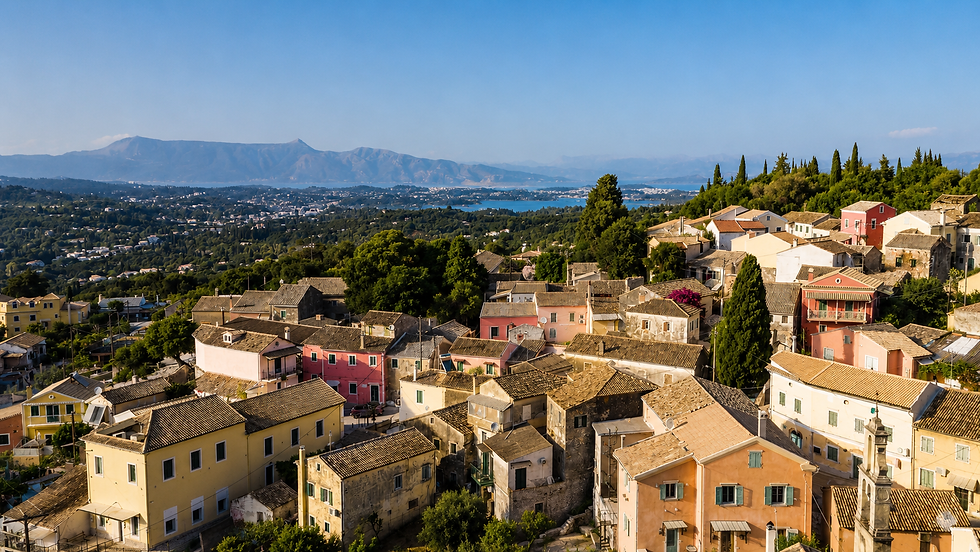
Gastouri – A Traditional Village in the Heart of Corfu
Gastouri is located approximately 10 kilometres south of Corfu Town, in a beautiful green area overlooking the eastern side of the island.
Unlike Corfu’s busy coastal resorts, Gastouri has maintained much of its traditional character. Narrow streets, old stone houses, small squares and local cafés create a peaceful atmosphere that invites visitors to slow down and experience a different side of Corfu.
Walking through the village, you can still feel the charm of traditional Corfiot life.
However, Gastouri became internationally famous for one very important reason: the Achilleion Palace.
Achilleion Palace – The Palace of Empress Sisi
The Achilleion Palace is one of the most iconic historical attractions in Corfu.
It was built between 1889 and 1891 for Empress Elisabeth of Austria, who was fascinated by Greek mythology, classical Greece and especially the legendary hero Achilles.
Following the tragic death of her son, Crown Prince Rudolf, Elisabeth sought a peaceful retreat away from the imperial court. Corfu, with its natural beauty, Mediterranean climate and connection to ancient Greek culture, became a place particularly close to her heart.
She chose the area of Gastouri to create her private sanctuary.
The palace was named Achilleion, in honour of Achilles.
Architecture Inspired by Ancient Greece
The architecture and decoration of the Achilleion reflect Empress Elisabeth’s admiration for ancient Greek culture.
Classical columns, statues, terraces and mythological themes appear throughout the palace and its gardens.
One of its most famous works of art is the statue known as the “Dying Achilles”, depicting the wounded Greek hero during his final moments.
The gardens also feature the impressive “Achilles Triumphant”, portraying Achilles standing proudly as a victorious warrior.
Together, these statues reflect two very different images of the legendary hero: vulnerability and triumph.

From Empress Elisabeth to Kaiser Wilhelm II
After the assassination of Empress Elisabeth in Geneva in 1898, the Achilleion eventually passed into the hands of another important European royal figure.
In 1907, the palace was purchased by Kaiser Wilhelm II of Germany.
Wilhelm was also fascinated by Corfu and frequently visited the island. Under his ownership, several changes were made to the palace and its gardens.
The Achilleion consequently became connected with two of the most recognisable personalities of European royalty at the end of the 19th and beginning of the 20th century.
The Gardens and Views of the Achilleion
One of the highlights of a visit to the Achilleion is its beautiful gardens.
Decorated with statues inspired by Greek mythology and surrounded by Mediterranean vegetation, the gardens offer an elegant setting for a relaxing walk.
From the elevated terraces, visitors can enjoy wonderful views towards the Ionian Sea and the surrounding Corfiot countryside.
It is easy to understand why Empress Elisabeth selected this peaceful location as her personal retreat.

Why Visit Gastouri and the Achilleion?
Gastouri and the Achilleion are ideal for travellers who want to discover more than Corfu’s beaches.
A visit combines history, architecture, Greek mythology, beautiful scenery and traditional village life in a single destination.
Gastouri is also conveniently located for visitors staying in Corfu Town or travelling through the central and southern parts of the island.
The area can easily be combined with nearby destinations such as Benitses, Perama, Kanoni and Corfu Town, making it an excellent addition to a half-day sightseeing itinerary.
How to Get to Gastouri and the Achilleion
Gastouri is located approximately 10 kilometres from Corfu Town and is easily accessible by road.
For visitors arriving at Corfu International Airport, travelling with luggage or simply wishing to avoid worrying about routes, parking or transportation arrangements, a private transfer is one of the most convenient ways to reach Gastouri.
A professional private transfer allows you to travel directly from Corfu Airport, Corfu Port or your accommodation to Gastouri and the Achilleion in comfort.
Private Transfer to Gastouri & Achilleion
At Corfu VIP Rides, we provide private transportation to Gastouri and the Achilleion from Corfu Airport, Corfu Port and locations throughout the island.
Whether Gastouri is your accommodation destination or you would simply like to include the Achilleion in your Corfu itinerary, private transportation offers a comfortable and flexible way to travel.
Our services include:
Private Corfu Airport transfers
Private Corfu Port transfers
Transfers to hotels and villas in Gastouri
Transportation to the Achilleion area
Private sightseeing transportation
Comfortable vehicles for couples, families and groups
Discover a Different Side of Corfu
Corfu is famous for its beaches and crystal-clear waters, but its history and culture are equally fascinating.
Gastouri and the Achilleion Palace tell a story that connects Corfu, Greek mythology and European imperial history in a truly unique setting.
Whether you are interested in history, architecture and photography or simply want to discover one of Corfu’s most celebrated landmarks, Gastouri deserves a place on your itinerary.
Take some time to walk through the village, discover the story of Empress Elisabeth and admire the gardens and classical beauty of the Achilleion.
It is a journey into one of the most elegant chapters of Corfu’s history.


Comments